

Strong Growth in Sub-Saharan Africa, but Pockets of Difficulty
During the past decade, growing links with emerging markets have supported the region’s expansion and economic diversification but have also increased its vulnerability to external shocks.
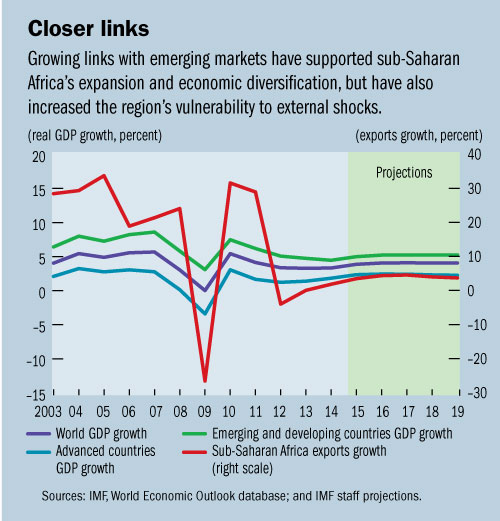
Although global growth is projected to gradually strengthen, an expected deceleration in emerging markets and a rebalancing of Chinese demand toward private consumption will make the external environment less supportive for the region. In particular, these trends could soften global demand for key sub-Saharan African exports, including commodities.
Tightening financial conditions — stemming from a faster-than-expected normalization of U.S. monetary policy, adverse geopolitical developments, or a worsening of the countries’ fundamentals — could also result in lower and more expensive access to external funding and a scaling down of foreign direct investment.
Sustaining high growth
For the vast majority of the countries the over-riding policy objective remains sustaining high growth to facilitate employment creation and inclusive growth, while preserving macroeconomic stability. Countries should continue to prioritize growth-enhancing measures, including by directing public spending toward investment in infrastructure and other development spending and safeguarding social safety nets.
Boosting fiscal revenue mobilization and improving the business climate also remain important policy priorities. Monetary policies should continue to focus on consolidating the gains achieved in recent years in reducing inflation.
In the few countries where large fiscal deficits and sharply risen current spending have become a cause of concern, these imbalances should be addressed but fiscal consolidation should avoid overly adverse consequences on the poor and other vulnerable groups.
Addressing infrastructure deficit
A study reviews the progress achieved in recent years by countries in sub-Saharan Africa in fulfilling their need to expand their infrastructure, highlighting the current trends in financing these operations and the challenges that lie ahead. The study finds that many countries in the region have sustained a high level of public investment, but only some of them have managed to improve their infrastructure significantly.
The major obstacle to addressing the continent’s infrastructure deficit does not generally appear to be a lack of financing, but rather capacity constraints in developing and implementing projects. The study concludes that countries should seek to make the most of new financing instruments and flows by improving their absorptive capacity and removing remaining regulatory constraints, while controlling fiscal risks and maintaining debt sustainability.
More specifically, countries should strengthen their public financial management capacity by upgrading their methods to plan, execute, and monitor public investment, strengthening their project appraisal procedures, and adopting a medium-term budgetary framework that includes adequate provisions for the cost of operation and maintenance. Public-private partnerships can be an effective tool to upgrade infrastructure, but need to be underpinned by an appropriate institutional and legal framework, and to be carefully monitored to minimize fiscal risks.
Excerpt: By Marco Pani
IMF African Department


