

The New Reality of Venture Capital
Disconnect between value creation and capture
The venture capital industry creates value that far outweighs the dollars allocated to it. But ten year returns to investors haven’t reflected that fact.
Innovation presents opportunities to solve customer problems more effectively and efficiently. But creating solutions that don’t yet exist involves a high degree of uncertainty. Usually, you need to spend a considerable amount of time and money before you know your efforts are going to pan out. That’s where risk capital comes into play; private investors invest money with the hopes of earning outsized returns to account for the level of risk they’re taking
.
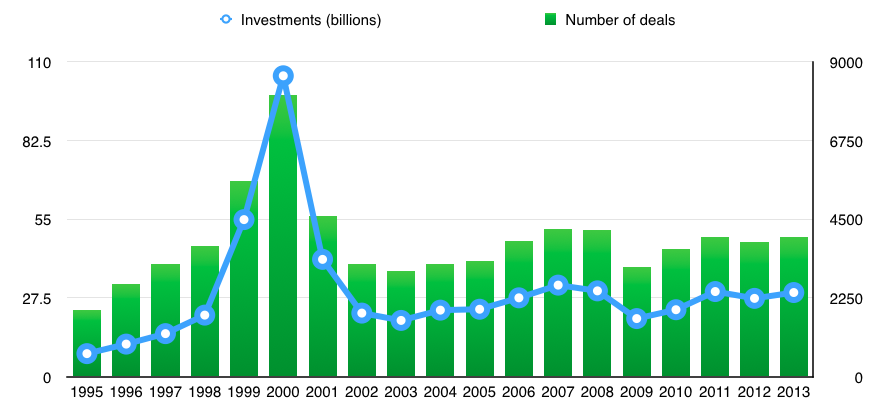
Source: PricewaterhouseCoopers/National Venture Capital Association
Venture Capital is one of the most important sources of risk capital around. Limited Partners (LPs) commit money to venture capital funds managed by General Partners (GPs). In aggregate, US GPs put roughly $25 billion to work every year. That might sound like a lot of money, but it’s less than 0.2% of US GDP.
Yet that 0.2% has been key in creating companies that account for 21% of the US GDP, and over 11% of private sector jobs (read the report). A tiny fraction of GDP invested by venture firms every year has been instrumental in creating more than one-fifth of the value in our economy.
Of course, venture financing isn’t the only funding source most of these successful companies have used to get where they are. After getting their venture dollars, many have taken in money from banks, mezzanine funds, and public offerings. But for most of these companies, it was venture financing that made them big; by the time they qualify for later-stage funding events, their valuations are often huge.
Clearly, venture capital investing results in tremendous asset value creation, particularly when compared to the dollar inputs.


